Showing posts with label teaching. Show all posts

Friday, April 24, 2015

Setting a New Course


Sometimes, the universe is sending you a message and you refuse to hear it. Sometimes, you hear it and ignore it for a while, until the din is too loud, the message unavoidable. And even then, doubt makes you hesitate, even though every sign points to yes.

A couple of weeks ago, I told my colleagues that I wanted to let go of the unpaid work I was doing at the lovely school where I teach—I'm just over half-time and had taken on much of the extracurricular work of a full-time teacher, including establishing a new diversity program. Then we went on our trip. I thought some more. I feel proud of a lot of the work I am doing. I know I'm a good teacher, and I love working with adolescents, who are so eager to discuss everything. I hope the school is a better place for my having been there. And I know that my kids are better off for having been there. I'm a better parent, in some ways.


Having four-year-olds is easier than having toddlers, mostly: they can be remarkably independent and creative. Sometimes I get a break—they go into their room, into the brother zone, and play beautifully. And at the same time, they're equally, if not more, exhausting. That two-hour nap in the middle of the day, during which I would daydream, write, get some work done, and drink tea? It's long gone, replaced by wrestling with two energetic chatterboxes who can't sleep at night if they take a nap. "Quiet time" consists of my scuttling from room to room while they try to play on top of my head. Yet this age is so short. In a couple of years, they'll be in first grade, learning to read and write, finding deep interests.


Last Friday, I drove to school feeling certain. I taught my classes, sat down to talk with the high school coordinator about a diversity issue, then closed with, "Well, I guess now is the time when I say I'm not coming back next year." The clarity and lightness I felt stayed there until I told my kids' teacher. I have loved all the teachers my boys have had at this school, and nothing has made this decision harder than having to say goodbye to them. It is perhaps fitting that I'm coming around to this decision while I'm in the middle of teaching The Odyssey for the fifth or sixth time. That text never gets old, with its questions of what it means to be a good human being, and its pursuit of the peace of home in a world full of monsters and disasters.

My Facebook feed is full of everybody's real-life disasters and joys. If disaster visits me, shouldn't I have spent some time stretching away from the easy comfort zone of the familiar into new territories? I'm not sure that I'm quitting teaching—in fact, I'm considering shifting my teaching to a slightly different age group. I'll still be doing some work with teens, this time as a college application essay tutor. So let us say for now that I'm quitting this particular combination of joys and costs.


I don't know what I'll be doing this time next year. I don't know what the kids will be doing.

But I know a few things:

I am choosing rest.

I am choosing to connect regularly, not just on Facebook, with my friends.

I will be writing more, more often.

I will walk more every day, alone, and with four-year-olds to guide me.

I will spend 10 minutes sitting in my backyard every day watching the plants grow, and listening to the boys play.

I will make a Southern-style Wish Tree—call it a Wish in A Bottle Tree.

I will learn new things and find new ways to teach people.

I was on my way home from watching some of my students present their 8th grade projects a week ago, the evening after I'd declared my intention not to return to EWS next fall. As I drove down the winding, dark road from Chapel Hill to Durham, I found an old mix CD, cryptically labeled "Hip Hop," and put it on. A few tracks in, Aesop Rock's "No Regrets" played, with its propulsive refrain:
You can dream a little dream
Or you can live a little dream
I'd rather live it
'cause dreamers always chase
But never get it
It's time to live the dream, not just dream it. Here we go: more smiles, adventures, and joys unknown.


Thursday, September 27, 2012

Waking Up


My class read an excerpt from the opening of Proust's Remembrance of Things Past for today's discussion. As a prelude to the discussion, we're writing about waking up. Here's my contribution:

I am startled out of my dream. I still see the waves closing over a spit of sand, the tide coming in. I was on an island, desperately trying to preserve some books (from what? I'm not sure) by slinging reusable grocery bags over my shoulders. I was holding the hand of someone tall, lanky, and blond. The waves rolled over us; we were underwater. I surfaced, with bags but no books. Climbed to the town on higher ground, still seeking the weighty load that had vanished under the sea. Darkness. Then I notice the edges of the curtains and the glow of the light outside. I swim out from the sea into my room. I am warm, sweating. My husband slumbers and snores next to me. I hear the BART train whoosh by with its ghostlike howl. What woke me up? The children are silent. It is four fifty-five, the glow of my clock tells me. For a week we've been waking up at four fifty-five. But no one is crying this time. I want to pull the covers over my head, go back to sleep, not start the day just yet. I roll over, hoping to find the waves, the shore, the books again.

Thursday, April 26, 2012

On Teaching Huckleberry Finn

Source: http://www.shmoop.com/images/teachers_editions/huck-finn.jpg
All modern American literature comes from one book by Mark Twain called Huckleberry Finn. American writing comes from that. There was nothing before. There has been nothing as good since. (Ernest Hemingway)


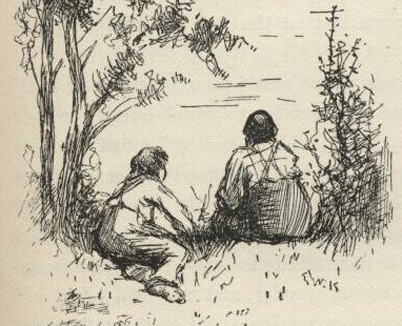
I just finished teaching Huckleberry Finn. As part of our time studying Huckleberry Finn, my class watched "Born to Trouble," a PBS documentary produced in 2000 about the controversy involved in teaching Huckleberry Finn. I was particularly struck this time around by something Jocelyn Chadwick-Joshua asks: "When did we decide that learning has to be painless?" When I first encountered Huck and Jim as a high school student, I felt offended every time I saw the word "nigger." I felt personally scarred. To be honest, I don't remember what, if anything, my teacher did to address the presence of the n-word in the book we were reading. I do know that when I started teaching Huck Finn three years ago I decided that the first thing I needed to do was tell my students what my experience was as a high-school reader of the text. Painful, yes. And in some ways it still is. The word hasn't lost its force. But Chadwick-Joshua and many of the other scholars who speak in the documentary argue that banning or bowdlerizing Huck Finn means taking one of its primary lessons away, and I'm right with them. The pain of seeing the n-word 218 times forces us to examine the power of words.

In his introduction to a recent edition of Tom Sawyer and The Adventures of Huckleberry Finn that does away with the n-word, Alan Gribben suggests that learning shouldn't in fact be painful:
I believe that a significant number of school teachers, college instructors, and general readers will welcome the option of an edition of Twain’s fused novels that spares the reader from a racial slur that never seems to lose its vitriol. Despite occasional efforts of rap and hip hop musicians to appropriate the term, and well-meaning but usually futile (from my own experience) endeavors by classroom teachers to inoculate their students against it by using Huckleberry Finn as a springboard to discuss its etymology and cultural history, the n-word remains inarguably the most inflammatory word in the English language.
I disagree with Gribben that the purpose of discussing the n-word is to "inoculate students against it." We start off each term's exploration of Huck Finn with a 70 minute discussion of the n-word. Only a few minutes of that conversation are devoted to its etymology. The purpose of discussing the n-word is to bring to the surface the pain, awkwardness, discomfort, and tension that encountering the word creates in both my students and me. I asked this year's students to describe how they felt during our initial n-word conversation. They mentioned feeling antsy, having a sense of hesitation, fear, or caution; many of the white students said that they noticed their whiteness more and felt separated or ashamed.  I asked whether there were any positive feelings about the conversation and they came up with the following words: insightful, important, boundary-pushing, good for learning, revealing, enlightening, necessary.

We have to consider such conversations to be mere starting points for further discussion, of course—after all, the purpose of education isn't to make us comfortable or complacent, but rather to encourage us to think for ourselves and question the world. What better way to do so than by directly confronting what Gribben rightly calls "the most inflammatory word in the English language"? Our lives are complex and difficult—avoiding the pain language evokes doesn't help us get better at contending with offensive, complex language (and avoiding the n-word while reading Huck Finn doesn't mean that you'll avoid seeing it rear its ugly head elsewhere: witness the reaction to last night's Washington Capitals win, for example). 

In addition to our n-word discussion this year, we spent a day talking about the new edition and whether it would have been a preferable text to read. In preparation for that discussion, we read Toni Morrison's introduction [PDF]  to Huck Finn from 1996, Gribben's introduction to this new edition, and a brief piece from Shelley Fisher Fishkin on the new edition. We also watched a brief segment featuring Melissa Harris-Perry on MSNBC's Countdown.The consensus among the class was that the book should be read as is, even in high schools, though it must be done with time to talk about the n-word. My students brought up the example that Gribben cites below as one instance in which "slave" is an insufficient replacement for "nigger":
The synonym “slave” expresses the cultural racism that Twain sought to convey, as in Huck Finn’s report to Aunt Sally Phelps in Chapter 32 that a steamboat explosion had “killed a slave,” to which she responds heartlessly, “Well, it’s lucky; because sometimes people do get hurt.”
As my students pointed out, the distinction here is between a "nigger" and a "person," not between someone who has been enslaved and a free person. But we could see how Gribben might be able to finesse his point by saying that the distinction between "slave" and "people" is exactly the same distinction. But in another passage, his replacement of the n-word with "slave" shifts the tone and meaning of the passage:
 "Oh, yes, this is a wonderful govment, wonderful. Why, looky here. There was a free nigger there from Ohio -- a mulatter, most as white as a white man. He had the whitest shirt on you ever see, too, and the shiniest hat; and there ain't a man in that town that's got as fine clothes as what he had; and he had a gold watch and chain, and a silver-headed cane -- the awfulest old gray-headed nabob in the State. And what do you think? They said he was a p'fessor in a college, and could talk all kinds of languages, and knowed everything. And that ain't the wust. They said he could vote when he was at home. Well, that let me out. Thinks I, what is the country a-coming to? It was 'lection day, and I was just about to go and vote myself if I warn't too drunk to get there; but when they told me there was a State in this country where they'd let that nigger vote, I drawed out. I says I'll never vote agin. Them's the very words I said; they all heard me; and the country may rot for all me -- I'll never vote agin as long as I live. And to see the cool way of that nigger -- why, he wouldn't a give me the road if I hadn't shoved him out o' the way. I says to the people, why ain't this nigger put up at auction and sold? -- that's what I want to know. And what do you reckon they said? Why, they said he couldn't be sold till he'd been in the State six months, and he hadn't been there that long yet. There, now -- that's a specimen. They call that a govment that can't sell a free nigger till he's been in the State six months. Here's a govment that calls itself a govment, and lets on to be a govment, and thinks it is a govment, and yet's got to set stock-still for six whole months before it can take a hold of a prowling, thieving, infernal, white-shirted free nigger...
Pap Finn's rant from Chapter 6 is crucial to our understanding of Pap as a hypocritical, racist, unsympathetic character. Perhaps we cheer a little when we find out at the end of the novel that he is dead. Perhaps not. Either way, it is clear that Twain knows exactly what kind of person his readers will understand Pap to be. Consider this brief excerpt from the passage above if we replace "nigger" with "slave":
Thinks I, what is the country a-coming to? It was 'lection day, and I was just about to go and vote myself if I warn't too drunk to get there; but when they told me there was a State in this country where they'd let that slave vote, I drawed out. I says I'll never vote agin. Them's the very words I said; they all heard me; and the country may rot for all me -- I'll never vote agin as long as I live. And to see the cool way of that slave -- why, he wouldn't a give me the road if I hadn't shoved him out o' the way. I says to the people, why ain't this slave put up at auction and sold?
The passage loses its force entirely; indeed, it doesn't make any sense, because Pap is explicitly talking about a black person who is not, in fact, a slave.

A further complication to Gribben's argument is the subtlety of Huck's development in the novel. Huck is a flawed protagonist—he grows and learns over the course of the novel, but he is infuriatingly silent in many places (as Toni Morrison has pointed out). Many of the 218 uses of the n-word in the novel come from Huck's mouth (cf. Louie C.K. on Huck). But in two places Huck does not refer to Jim as a "nigger," and those two places stand out even more because they are so unusual.

The first is when Jim stays to watch over the injured Tom Sawyer at the end of the novel, after Jim has been "freed" by Tom and Huck. Because of his willingness to risk his freedom for Tom's sake, Huck declares that he "knowed [Jim] was white inside" (365). For Huck, this is progress, though such a compliment wouldn't (and shouldn't!) be acceptable these days.

The second, and more poignant, moment comes when Huck hears the doctor's account of Jim's behavior while the two of them tended to Tom's wounds. The doctor's speech has been freely peppered with the n-word, even though he is arguing that the townsfolk should treat Jim kindly—by my count, "nigger" appears 10 times in the speech. Huck feels relieved by the doctor's speech, and tells us that he "thought [Jim] had a good heart in him and was a good man the first time I see him" (378). This is the only moment in the novel in which Huck refers to Jim as a man. Would the effect of this exception be so potent if Jim had been referred to as a "slave" throughout the novel? I doubt it. Our eyes can slide over the word slave. But "nigger" jumps off the page and sears our consciousness, as does its absence in this instance.

I wish I could say that teaching The Adventures of Huckleberry Finn is always satisfying—in many ways, it is an incredibly frustrating book because Huck is flawed. While he grows to realize that Jim is a good human being (as we readers have known all along), he doesn't extend that understanding to all black folks. In fact, he forgets about Jim's humanity and goes along (albeit grudgingly) with Tom's plans for much of the last several chapters. Yet a flawed protagonist is in many ways a better foil for our smug sense of superiority as modern-day readers. We, too, would do well to examine our assumptions about how we judge and classify others. Do we, like Huck, make exemptions for individuals? Or do we, like Jim, let our better impulses rule even if it means risking our own self-interest?

[Note: I began writing this blog post about three days before the twins made their appearance in January 2011; at the time, all sorts of media were carrying the story of Gribben's new edition of The Adventures of Huckleberry Finn. I think this piece has probably taken longer to finish than any other piece of writing I have ever done, with the exception perhaps of my Master's thesis. Maybe.]


Thursday, February 23, 2012

Stuff My Students Say, and Stuff I Say to Them

No extended commentary below, but I've been meaning to archive these things somewhere:

  1. Student: "Why do you guys always say this: 'remember, characters don't know they're in a book'? You always say it so that we won't say stuff like 'On page 54...', but that way of explaining it doesn't make sense. What makes more sense is for you to say: 'the reader of the essay won't connect with the page number--it means nothing without the context.'" Brilliant. I'm going to use that explanation from now on.
  2. Regular readers of this blog will know that I constantly question what we're doing in English classes, and specifically how analytical writing relates to both the texts we're reading and what our students need. In conversation with Gracie during class one day, I came up with this: "All literary analysis boils down to why you should read this book." Not like a book review, but rather, what the text tells you about the world, yourself, language, and so on. I'm still not sure that's the right answer to the question "What's the point of writing these essays?" But it's one of them.
  3. Another answer: You're lifting weights. I don't expect many of my students to become academics. But while our culture is indeed becoming increasingly visual, it's also becoming even more based in the written word. For every wordless photoessay, there are many more written responses. Writing analytical essays is to the actual writing you do in life as lifting weights is to playing a sport well. It's not the thing itself, but a way of strengthening your muscles for the thing itself.


Tuesday, November 8, 2011

In the Park

Today I walked with my Advanced Comp students to Golden Gate Park. We walked in silence for the first 20 minutes, then chatted as we walked back. There's something freeing about being outside of the classroom and not expecting something specific to come out of the experience. I hope my students felt the same way. I love walking in silence with teens; so much of their time is spent talking and listening to music that it can be good for them to just stop the noise and tune into themselves. I know some of them broke the silence early, but for a few minutes at least we were all in the same place.

Usually, when I'm in a park these days it's with my babies. I'm making sure they don't eat rocks and leaves, providing a climbing surface, and running after them as they crawl in opposite directions. I saw all the parents and nannies at the park with their charges and wished that my boys were with me and I was watching them play in the sandbox. I wanted to raise my hand and say: "I'm a parent, too! I have twin boys! I love them! Yeah, I know you think I have my hands full with twins. That's ok with me." Instead, I smiled as I watched two girls from my class swing high, and watched the boys from my class sit and enjoy the shade. I guess I did have kids with me.

Tuesday, September 27, 2011

A Gatsby Passage

I'm asking my students to do this right now, so I'll play along and take it a step further by posting in public. The prompt: Write for 10 minutes on a passage in the book you're reading. Choose a passage that makes you feel something—an emotion, a memory, a pleasure in language, a frustration with the character. Respond to the passage on an emotional level, not an analytical level.

I'll write about The Great Gatsby, which fewer of my students chose than The Catcher in the Rye. The passage I've chosen is from the first chapter:

"And so with the sunshine and the great bursts of leaves growing on the trees, just as things grow in fast movies, I had the familiar conviction that life was beginning over again with the summer." (4)

I know exactly what Nick means here. Or at least I have a sense of it. There's a time of year when everything seems to move incredibly quickly, the trees glow as if they're lit from within, and everywhere you look, things change and shift and blossom. The "fast movies" remind me of looking at my photos from the last year—in each album, the babies seem to grow exponentially, getting bigger and bigger and bigger and turning from little larval beings into the tiny people they've now become. Because I've spent so much of my life in academic environments, I always associate fall with beginning life over again. But perhaps now that I'm freer in the summer to watch things (people!) bloom and grow the summer will become my realm of endless possibility.


Tuesday, September 13, 2011

Back to Work

It has been almost exactly three months since I last posted here. I have several posts that I started, but stopped working on when babies woke up or while I ran to the store, or did any of a million other things I do with my time when I'm not feeding or entertaining babies.

But school has started, and I'm back at work. Fortunately, I'm teaching my favorite class in two sections this term (and that's all--I am very grateful to be teaching only part-time). The lovely thing about teaching a writing class is being able to have some time, even if only a few moments, in which to write for myself.

So here I am. And, dear readers, I have so many things to tell you about. I have notes all over the place about things I want to write about. About being a mom and a teacher at the same time, about trying to also fulfill my other roles (wife, daughter, friend) and mostly failing. About sometimes thinking I'm not so good even at the mom stuff, even though I've been working really hard at it for 8 months now. And about how quickly the boys are growing and changing and how amazing it is to watch. And how I can't wait for the day when they sleep just a little bit better, so I can sleep better too. And, yes, about what I'm doing in my class this fall, and whether I think it's working.

And maybe I'll get to write about all of those things sometime soon. For now, being back at work--even part-time, even teaching a class for the fourth time--is hard. I'd like to say that I feel more whole and more complete interacting with older children and adults than I did while endlessly walking around the neighborhood with the twins. And in some ways I do. I love my job. I love working with teens. I love teaching writing. It's nice to see other adults and to think about the nuts and bolts of teaching. But few of my colleagues are really interested in the two small people that I'm most focused on right now. And that's isolating in a different way from being stuck at home trying to maintain a nap schedule.

Thursday, October 21, 2010

The Big Picture

Recently, I met with a consultant the school is bringing in to help us with our inquiry work. She pushed a few of my ideas further, and helped me clarify some of the ways I'm going to go about working on this project. But she also suggested that I ask some bigger-picture questions about the curriculum we teach and why we teach what we teach. One of the questions we came up with was: how does the stuff we teach actually lead to critical thinking?

The question came up as I described to her my struggles with teaching literary analysis in a way that lets students' hearts be in their work. It's not easy. So she asked me why we have to teach it at all. I came up with the usual reasons: writing such essays is required in college, and becoming skilled at literary analysis will benefit our students by making them better critical thinkers—if they can dissect a text, then they can dissect anything else. But as I teach freshmen the rudiments of such analysis this fall, I am reminded of just how difficult a genre it is, and just how arbitrary some of the rules may seem. Is asking students to fit into this mold also somehow depriving them of developing their own critical voices? Or are there ways to get them into this mode that allow for more freedom?

In Advanced Comp, I've been experimenting with allowing students to choose their texts for the analytical writing portion of the class. In part, my decision to do so is grounded in the idea that choice is incredibly important to writers. In the real world, scholars choose both their field of study and their concentrations, even though they do have to sometimes take courses (and write papers) that are out of their particular concentration. So why wouldn't high school students benefit from an element of choice in what they study? This year's experiment has gone well: I have four groups reading four books, and they're working with each other to understand the texts and write about them. That doesn't mean that they love expository writing—they're all excited to move on to writing personal narrative next week. But giving them choice does mean that they've made an investment that they have in the texts that they might not otherwise have. As one student put it to me when I asked them how choosing books was different, "Even if I hate the book, I'd still be like, this is cool because I chose it."

But those are seniors; they've spent the last four years working their analytical muscles, and while they don't all feel that they're strong writers, they do know what the expectations are for their writing. What can I do with freshmen to engage them more in the process of writing out their thoughts?

Several things come to mind, many of which I use regularly in my classes: informal writing serves often as a bridge between thinking and talking in class and writing formal papers; open time for journaling gives my students time to use writing for something other than analysis; sometimes I say during a particularly good discussion that the way we're breaking down the text is exactly what students are supposed to do in their essays. But few of these tactics lead to my students' feeling anything more than frustrated with the process of learning to write this way—there isn't always the joy of discovery as students first begin learning to write analytically. Older students do get this joy: once they're not struggling all the time with form, the ideas/content can become engaging in and of itself. At that point, they're thinking critically, and happy to do so.

Back to teaching freshmen critical thinking: I need to collect information about my primary question. (How do I make writing something that all students feel they are both able to do and able to improve upon?) I need to find a way to pursue this question that allows me to see tangible results. And I needed to start collecting that data three weeks ago (funny how work gets in the way of work sometimes...). Here's what I'm going to do in the next week: make a quick check-in survey for my frosh, see what they say, and try to tweak some practices in the final stretch of the class. I'll work with a couple of students in particular to see if I can help them stretch those analytical muscles a bit more. And I'll report back, sooner than a month from now.

Monday, August 9, 2010

Back to the Salt Mines

That's one phrase I'm going to try to eliminate from my thinking about teaching this year. And any other similar phrases. As this Profhacker post reminds me, the words we use affect our attitudes:
Each time you say something like “back to the salt mines” (which is usually accompanied by a shrug, or slumped shoulders) you reinforce your own attitudes about your workplace as being somehow like a dangerous mine where prisoners labor.  Sure, maybe you didn’t mean it, or not at a conscious level.  But if you think or say “salt mines,” “salt mines,” “salt mines,” several times a day, you’re probably not going to be feeling lively, energized, or creative.
Attitude makes a difference. I should know better than to adopt a negative attitude toward the work I'm doing (yes, this is another thing I've learned from yoga). Teaching is often hard work, but so is much of life. So, the next time I talk about the misery of grading, or being buried under course reports, I will try to be more conscious about my attitude: the grading is there to serve my students' learning, not to torture me. Interims and course reports serve the same purpose; in fact, they liberate me from the tyranny of letter grades. So I should be grateful, or at the very least, accepting, of the parts of teaching that aren't necessarily fun. And then I should keep trying to find ways to be more efficient and effective at those things, so I can spend more time on the fun stuff.

Thursday, August 5, 2010

Details

Iris, garden, April 2010
My yoga teacher posed this question at the end of class the other day: Where or when in your life have you allowed the details to become more important than the thing they were serving, AND when have you not paid enough attention to the details sacrificing that bigger picture?

My short answer: Um, all the time. For both options. Let's start with the first question.

Where or when in your life have you allowed the details to become more important than the thing they were serving? When I'm grading papers. All those comma splices and run-on sentences and misused words drive me nuts. And I sometimes lose track of my students' ideas (the big picture) when I focus on those details. But then again, if I don't focus on those details, my students won't become coherent writers. Right? Don't they need me to circle and point out their errors? When my teacher points out that I'm not pressing with the base of my index finger, she's not telling me I'm a bad yogi. She's asking me to be mindful of a detail that is essential to a strong foundation in all poses that require my hands to be on the mat. When I ask my students to pay attention to their syntax, I'm helping them build strong foundations for all the writing they'll do in their future lives. The details matter. But maybe they don't matter as much as I think they do—when a student's grammar is so atrocious that it takes me 30 minutes to get through a page, am I really serving that student by noting every single error? Probably not. A practice I'll try this year is to note repeated errors and have 5 minute conferences about those specific errors. Then I'll check the next paper for those same errors and see if there's improvement.

But what about the second question? Do I skip the details sometimes in search of the big picture (even at the expense of the big picture)? Maybe. I wonder if this isn't my major weakness as a teacher: I love to talk about the big, juicy stuff—the meaning of life stuff, the stuff that reading books is all about. I love to ponder the difficult questions with my students, and I love to see them drawing connections between themselves and the (often strange) folks in the texts we read. But, especially in upper level electives, do I err on this side too often? Would my upper level students benefit from the more direct explication that I ask for in lower level courses? Probably. Maybe I should start discussions more often with the plot, the themes, the characters, the setting, instead of asking students to extrapolate from what I assume they understand. In yoga, even the most basic poses can be incredibly challenging for an advanced practitioner, if you pay enough attention to the details. In fact, I've been through many excruciating adho mukha svanasanas (down dogs) and tadasanas (mountain poses)—thanks, Abby!

So, what do I do, now that I've acknowledged some of places where my teaching practice could be more refined?

1. Keep thinking about how I do assessment. (I've been poking around this guy's blog, wondering if there are insights I might glean—how can I adapt some of the methods he discusses to the kind of no-grades policy we have at Urban? Are there more efficient and more effective ways to give students feedback on their writing?)

2. Remember the details, particularly with older students. They may be faster at it, and they may need less coaching, but—especially considering the sheer length of the readings we often assign in electives—sometimes slowing down and going back to basics is a wise thing to do.

Monday, June 14, 2010

Reflections on 2009-2010

The Urban faculty had its closing meeting a few weeks ago—the last faculty meeting of the year. During the meeting, we reflected on a couple of things. First, in small groups, we shared a professional triumph or challenge. Then, with the full faculty, we shared our thoughts about one student whose growth/development we'd felt identified with in the last year. This process of reflection (along with the self-evaluation I wrote) has me thinking that it would be nice to list a few of the positives about the end of this year.

1. The student who started off the year with a lot of bad habits (late papers, a lack of participation in class, etc.). That student now writes poetry daily and tells me about it. Yay!

2. The book I got from a student accompanied by a heartfelt "thank you so much for....everything."

3. I'm pleased with the way my Advanced Composition class went this fall, and hope to preserve the elements that worked well, yet polish it for next fall.

4. I re-started a poetry class that had been dormant for a year, and got a bunch of students (see #1 above) interested in poetry. I hope next year's iteration of the class is even better.

Coming soon: another post that lay on the back burner over the last couple of weeks. It's not quite so self-congratulatory.

Sunday, May 16, 2010

Examining Writing, pt. 2

I left off here.

Assume, for the moment, that we're not going to stop teaching classes that focus on a region, a type of literature, or a theme. How do we revolutionize our teaching of writing without completely reinventing the wheel?

What are some practices that might help students become better writers and better thinkers? How can we get good essays without having to grade every draft and revision? How can we get students to see their own work critically?

Practices I've used with some success include regular journaling and freewriting a là Bard College. But that has usually been in the context of my Advanced Composition class, which I use as a laboratory for teaching writing; in the context of most other classes, so much time devoted to writing and sharing our writing would be impossible, since we'd also have to look at the text we're reading. I've also spent time using student work to discuss various aspects of analytical essay—the formal stuff like opening and closing paragraphs, integrating textual support, and making clean transitions between ideas. And I'm a huge fan of getting students to write about the text to each other in informal spaces.

But is it possible to assign papers that are less formal, yet that still approach the text and manipulate it in some way? In other words, if it's a given that students must learn how to write something resembling an analytical essay (and that's a big "if"), is it possible to go about it sneakily, by having them write something else, something they enjoy writing more? (Of course, there's another question that arises here: is school supposed to be about enjoyment?)

Should the writing reflect the reading? Or should it intersect with the world in a broader sense? I'm thinking right now of an essay I read in Urban's literary magazine, which is clearly influenced by a piece of literature, but isn't an analytical essay in the way that we teach it. But it is a great essay, and a fine piece of writing.

I know this post is long on questions and short on answers. But the reason I'm blogging isn't necessarily about stating all my beliefs and coming up with a list of the best possible practices for teaching English. I'm blogging to figure out what I think the big questions are and to reflect on what works and what doesn't work, and what I still need to figure out for myself as I continue teaching.

Friday, May 14, 2010

Examining Writing


So, Friday I had a good class. A really good class. One of those classes after which I remember why I'm a teacher, the kind of class that makes me thank my students for their awesomeness. On Friday, I spent 70 minutes talking about Plato's Apology with 13 sophomores. I had a student (a senior, who is "TAing" with me this term) come up with a few questions. He led the discussion, while I sat in as a participant, instead of the person at the front of the room. I mostly listened. A student who doesn't often speak up or get engaged in the conversation came up to me and said, "This is what English class is supposed to be. It's supposed to be talking about the books and relating them to our lives."

Indeed. "The unexamined life is not worth living," after all, and an English class is a good place for such examinations. The mirror, the prism of the text gives us a new way of seeing. A friend of mine likes to joke that English classes are really just group therapy. On Friday, that class did some deep examining, and engaged in some deep therapy. What I love about teaching is the moments like Friday's class—my students read and engage fully with a text that I love, a text that many have loved, and that text, even for just one moment, changes their lives. The thrill for me is being present at that moment of change.

But there's a catch: those moments are fleeting, even with the best combination of students and in the best of classes. The day-to-day work of teaching often beats back those bright moments into the shadows. The reading: not a problem. I like books. The planning: time-consuming, but I'm a planning kind of girl. When I'm not plotting and scheming about what and how to teach, I'm plotting and scheming about my garden, or my house, or what to cook all week. Even the faculty and committee meetings, when they're productive, aren't so bad.

No, I'm talking about the grading. Here's the question that drives most of my questioning and thinking about teaching as a career (examining, if you will): How can I make this job sustainable? How can I have time to live a fulfilled, examined life while still getting papers back to students in the amount of time that my department says is reasonable? There's no easy answer to these questions. In this post, I tried to get at some possible options for making the grading better while at the same time providing the kind of feedback that my students want and need. I've also been reading a bit about one possible way to make my giving of comments more efficient. Instead of dwelling on grading techniques right now, I'd like to spend more time looking at the very nature of the assignments we give.

I'm hardly the first person to say that the way we teach writing needs to be rethought. In fact, high school English as a discipline is a hodgepodge: we teach writing, we teach grammar, we teach critical thinking, we practice multicultural exploration through texts, and so much more. And we're therapists. But what's the purpose of all the stuff we teach? For me, it can't just be about getting my students into good colleges so that they can live productive, possibly happy (but perhaps unexamined) lives. It has to be bigger than that. Even explaining comma splices must be in service of a greater meaning and purpose. Allow me to quote myself:
I want them to show themselves to be insightful readers and speakers, and writers who write authentically, from the heart.
How do we get there from comments like this?
i personally think that it is useless to talk about grammar. when we are taking about themes/ideas that have to do with us, or things that we can choose to do/learn about that is when it becomes interesting for me.
(student response to my "How Do You Know? survey)
I'll posit some thoughts in my next post. Right now, it's time to examine my garden.

Thursday, May 13, 2010

Looking Back

Recently, at a meeting of second-year teachers at my school, we had a conversation about collaboration. Collaboration among colleagues is a big, deliberate deal at Urban, so we were asked to think about what makes for successful (and not-so-successful) collaborations. It was easy to make a list of frustrations with collaborative pairings that hadn’t worked out well—like a term in which I was the only person teaching a core course, a course that was new to me. I felt totally unmoored and unstable, and my teaching showed a lack of deliberation in planning and design. What that experience showed me was the value I find in having a functional team or at least a collaborative partner working on a course.

When we listed what made for successful collaboration, I had an easier time. What most often helps me is a flesh-and-blood check-in: how do you get them to look at the text’s more complex parts, when they’re struggling so much with keeping the characters straight? What do you think might be a better way to introduce this book? Should we tweak this prompt? How did yesterday's plan work?

Of course, even if we're collaborating closely, we don't have to teach in lockstep. I might want to experiment with something that my collaborator isn’t interested in, or I might want to add or subtract a text. But it’s great to share the results of those shifts and experiments with colleagues, and to see how their experience of the class can inform my own.

And not every collaborative meeting has to be in person. Sending emails with lesson plans back and forth can be quite fruitful, not to mention efficient. But I find that there’s often something else that comes up in conversation that might not occur to me as I’m hastily composing an email message. But the time for meeting face-to-face isn't always there, and the people aren't always there when the time's there. (Hence this blog and the long list of blogs I read.)

There's a lot to be said for the process of reflecting on one's teaching in a journal. But I've had the most insights when I've shared my successes and failures with others.

How do you collaborate? What tools do you use to share your work with your colleagues, whether in the same building or across the world?

Friday, May 7, 2010

How do you know?

It's the last six weeks of school. The runaway train is slowing down, and I'm slowing down even faster. I'm ready to step back from the hectic pace of the year and begin spending more time reflecting and planning, less time grading and prepping. But first I have to get through these six weeks.

All is not lost, however: I have a blog. And here, I can think about all of those things which I cannot yet indulge in too fully. I hope this is the beginning of my re-emergence as a blogger, and as a writer.

Here's what's on my mind today: As a part of the professional development required in my second year as a teacher at Urban, I've been asked to ask my students how they know how they're doing in my class. The answer to this question at almost any other school would be simple: this is your grade. But at Urban it's more complex. We can't just show a grade; in fact, we almost never tell students what their grades are (sorry about the PDF!). We write long narratives, with equally long rubrics. But no grades.

What does that mean for a subject like English, then? In practice, it often means that students are unsure of how they're doing. Even with detailed narratives, one-on-one meetings, and my frequent availability, they still feel like they don't have a sense of where their strengths and weaknesses are. The lack of clarity is more frustrating for freshmen and sophomores, who are still learning to see themselves. I find that my juniors and seniors seem to have a fairly strong idea of themselves as English students, especially themselves as writers. By that point in their Urban careers, they've written enough self-evaluations to begin to see themselves more clearly and honestly.

But I don't just teach juniors and seniors. I spend just as much time with freshmen and sophomores. What I found from an informal survey I took of students is that they do have a sense of what it means to succeed in English: they say that English is about analytical self-expression, in class discussion and in writing. And that's generally true. They say that they see how they're doing by reading comments on their papers, by the way I react to their comments in class, and by seeing how their peers react to what they say. They wish I could write even more on their papers and that they could see a timeline of progress toward the elusive goal of English perfection. I want that goal to seem less elusive.

I'm not going to write more on their papers; I write too much as is. So much of the challenge of teaching, and teaching well, is achieving balance between work and life. Yes, teaching is an all-consuming profession. But I don't want to be consumed by it. Pursuing a full life gives me more space in my teaching, gives me more reserves to draw on, and gives me more air to breathe.

But I wonder about how to get my students to chart their own progress, so they can better see their growth over time. Some initial thoughts:
  • Students create their own set of goals at the beginning of the term (I already have them do this, but less formally). As they achieve each goal, they can check it off and add a new goal.
  • I could read papers and make marginal notes and fill out a rubric for them (already a standard practice: students self-evaluate on the rubric first). But instead of an end note, I could take 5 minutes to talk with each student about the goals of the paper, what it has done well, and what needs work. Then students write in their own words what they are proud of and what they'd like to work on. The obvious constraint here is time. And this idea doesn't get at getting students to see/evaluate their participation in class.
Obviously, neither of the above ideas is perfect. But what they all have in common is a focus on getting the students to see themselves as essential parts of their own learning process. That's the goal. I want them to think of English as something they can do: I want them to show themselves to be insightful readers and speakers, and writers who write authentically, from the heart. They are all capable of achieving this ideal, but I don't think they all see the way to get there.

Thursday, October 11, 2007

Not Out of the Cave Yet


I have made it through the beginning of the school year! I have a course description prepared for my spring elective, I have great students this year, and I don't feel like the new kid on the block any more. I do feel like the kid who has too much to say about everything and who hasn't yet learned to keep her mouth shut. I see so many things we could be doing differently, from the way our schedule works to the way we assign papers. I wonder if we are not revolutionary enough. I wonder if we will ever be. I don't like being a revolutionary, but this phase of my life seems to be a revolutionary phase. Perhaps such thoughts are mere shadows on the cave wall. There is more to consider than revolution. I wonder what happened to me?

How did I go from being the girl who wanted to study only the classics, the great books, to being the woman who wants to see a more global approach to education? The desire to look for something new in the stream of discourse seems to me to be a privilege I have gained by dint of my education. That is not to say I wouldn't do it all over again. There is something about having spent four years learning for the sake of learning that is very precious to me. I want all of my smart, curious students to do the same. Even so, I wonder if the way to make classic texts available and interesting to the kids might be to integrate them purposefully and deliberately with a study of more contemporary texts, texts that are equally worthy of attention and study.

I wonder. But then I think that my passion for, e.g, the ancient Greeks shows when I teach the Odyssey to my freshmen and when I teach Sophocles to my sophomores. I prefer Socratic seminars to teacher-heavy lectures. Is that enough? (I doubt it, somehow. I know I can be a better teacher.) I wonder whether my students know that knowledge for its own sake is worthy of pursuit. (That's not entirely true; many of the students at my school have fascinating interests and know a great deal about plenty of things that I would never think of learning about.) I had a student inform me today that he could see why he might, as a future computer programmer or engineer, have a need for math, or science, or English. But he saw no need for history! I asked him whether he was planning to live his entire life without talking about the rest of the world or about politics in this country -- how could he expect to be an informed citizen without some knowledge of history?

I should not have been shocked, perhaps -- these are some very bright, very driven kids -- but I was never one of those kids. I was the kid who thought that in order to understand the world, I had to look at the origins of whatever world I lived in. For me, that meant the Greeks and Romans and Kant and Nietzsche and the rest of the canon. Now, I wonder how much of that canon my students will ever read; worse, I am guilty of the crime of wanting to read as much non-canonical literature as I possibly can. So I come back again to the idea of a privileged position. Time to change the topic:

Today was the day that I asked my students to think of essay-writing not as a chore, but as a way of expressing their thoughts. I asked them to describe aspects of writing that they enjoyed. After much thought and much sarcasm, they seemed to agree that the sense of satisfaction that arises from completing a thought or figuring out what they really mean to say was the most pleasant thing about writing. I spoke to them of my own struggles to write: I am a sporadic writer at best. The muse doesn't sing in me often. I am making a commitment to spend a few minutes every week reflecting on teaching, or life, or whatever on this here blog. The test will be over the next few weeks, the busiest of the school year. I am looking forward to being a part of the conversation, instead of solely taking in others' words, even if for a long time I am talking only to myself.