Wednesday, December 5, 2012

Being, at the park.

You've found the perfect park for your outing with twins. You have your bag packed with diapers, snacks, shoes, drinks, and a well-charged smartphone for snapping pics of your adorable offspring. You will *only* use your phone for occasional photos and checking the time. (See this New Yorker piece for an eloquent argument against even snapping photos) The rest of the time it stays in your bag. 

You have spare clothes if you're going somewhere you're likely to need them. You have jackets if it's going to be cold. You have sand toys for sand parks, and extra balls just in case. And you know that the park is going to be an easy place to keep track of your kids.

Friends are good, too—I try to meet up with one or two other moms a few times a week, especially other moms of twins. Being at the park with other people who know you and know your kids means that you have an extra set of eyes and ears. And there are likely to be fewer conflicts (in my experience, at least) because the kids know each other. After months of seeing the same people, the boys look forward to seeing their friends—and I look forward to seeing mine!


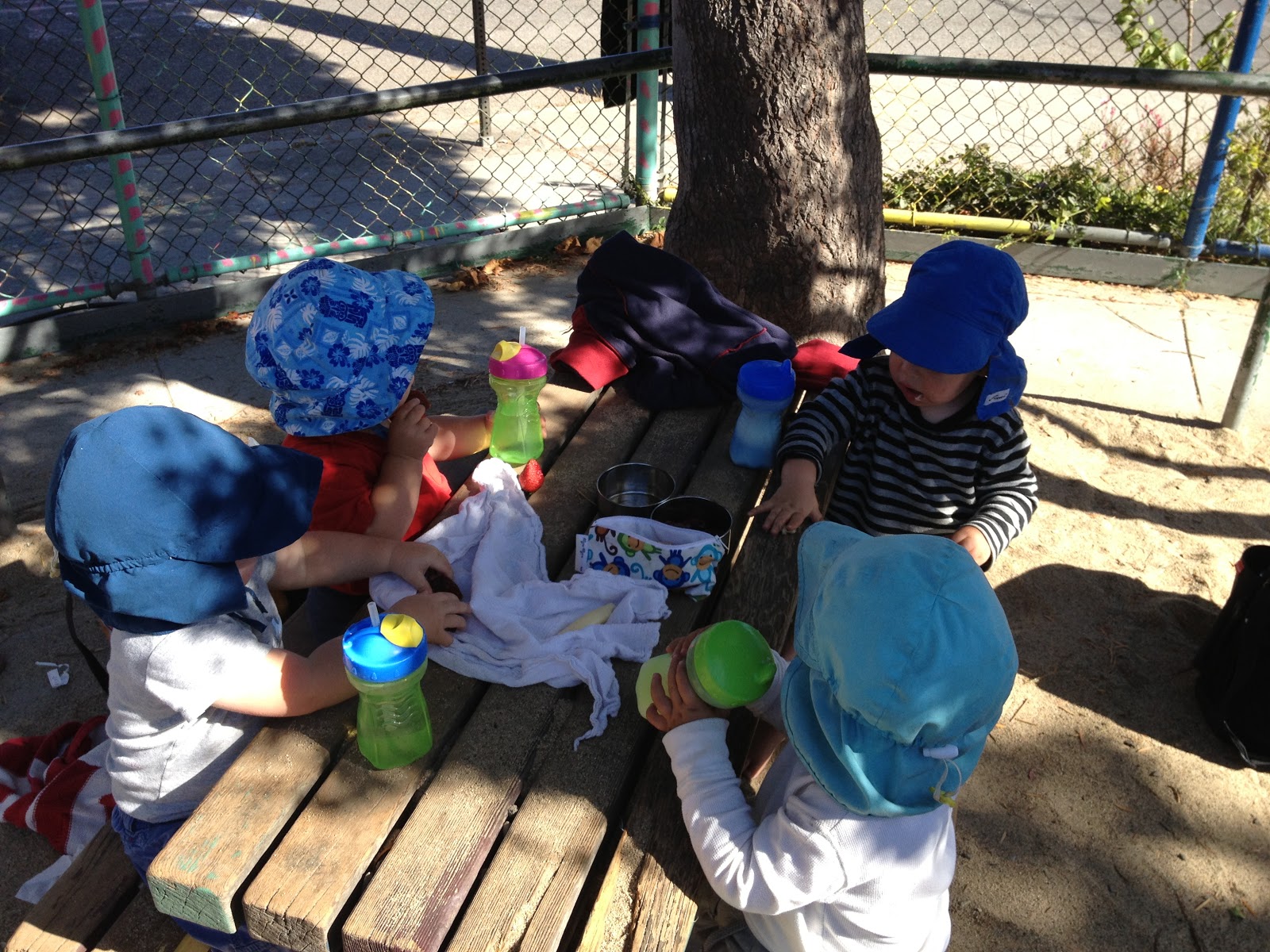
Sharing a snack with good friends


Even with all that, you need to bring a few more things: for starters, trust and patience. 


Trust is about believing that your children have their own interests and their own agendas. Do they want to go up the stairs? Great! Do they want to spend 30 minutes pushing a truck around? Great! Maybe they're into pouring sand. Maybe they don't want to use the shovel the way that you think they should use the shovel—that's ok, too. Don't force them to do what you think they should do—free, unstructured play is children's work. Just because you think your kid wants to swing or slide doesn't mean s/he wants to. Lots of times, kids like to climb the stairs to the slide, but not slide down. That's ok, too. They're working on climbing and enjoying feeling up high. When they want to come down, they'll figure out how. Your job at the park is to reinforce the boundaries that do matter: no hitting, biting, pushing. Use words to describe what happens when conflicts seem to be mounting; offer other choices when conflicts escalate. Acknowledge the problem, then see if your kids can come up with a solution.


11 months old, enjoying some stair play. Notice that they are in charge of how high, how fast, and how they go up.

I love this paragraph from Lisa Sunbury about play:
So what is your role as a parent or teacher of young children? The idea is for the adult to create an environment that invites play and then allow the child to explore and experiment within that environment to his heart’s content, without showing him how it’s supposed to be done. This leaves your child in control, and preserves his natural, inborn desire and ability (intrinsic motivation- from within) to play. When your child plays, he is not only learning, he is learning how to learn!
So trust your kids to find interesting things to do and see and explore. Trust them to know the limits of what their bodies can do. And trust that they will push those limits, too. You'll be there to catch them; you won't be holding their shirt while they walk and constantly telling them to be careful.


Janet Lansbury says it best:
The key to fostering an “I can” mentality is simple… Accept, appreciate and allow whatever children are able to do in that moment, rather than expecting or encouraging them to do more.

Patience: You have to learn to be patient with yourself, to let yourself sit back and watch. It's hard to do when you have two toddlers running in opposite directions. I've found that I'm most able to sit back and watch if they're running on the ground. Up high is hard. You want to help. I try to just stand close then, not interfere too much. My boys know that I trust them to know their limits, and usually, they're right. It's almost always when I second-guess them or try to "help" that they seem to falter and get frustrated. So, I try to remind myself to wait, wait, wait before stepping in. I don't always wait long enough, and I really don't wait long enough when I'm nervous or distracted. But doing this stuff is a practice. It takes time. It's really, really hard not to explain why they fell, when they do fall. My personal resolution is to do a better job of asking questions like "Would you like to try that again?" It's so easy to want to protect and direct. What you have to to is help them persist and discover. 


Yes, even 18-month-olds can share...if you let them work it out and don't yell at them to share.

And that's the thing about babies and toddlers: they take lots of time to do things. A four-block walk can take an hour. You can't have an agenda; if you do, you'll be frustrated. If you have plans, you have to be ready to listen to some complaints as you attend to the business of getting there. Plan to hear some crying, some screaming, plan that you might have to be firm about getting in the car, changing diapers, whatever. This is part of living with children. We adults are thinking five steps ahead. They're thinking about now. Slow down, take a look from their perspective. Part of many of our park outings these days is the walk to the park from our car. This can take up to twenty minutes. And that's fine.

Sometimes we stop to check out holiday lights. 


Here's what you really need to know about being at the park: it's about being, at the park. Take the time to watch your kids explore and learn. Follow their lead. Your job is to get them outside. Let them show you the rest.

Tuesday, November 20, 2012

How to entertain two toddlers.


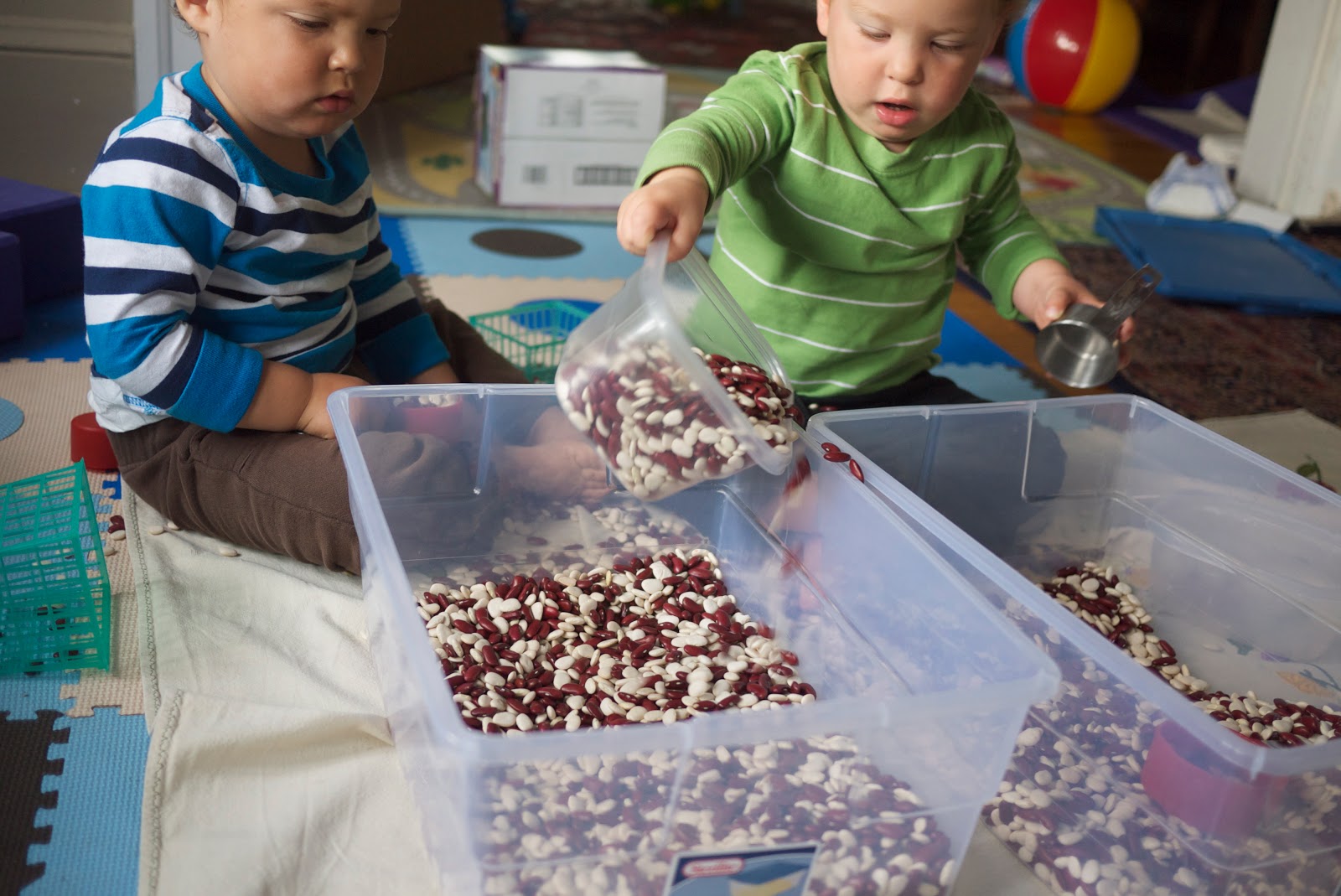
Step 1: Acquire beans. Put them in one or two large, clear plastic tubs. Provide measuring cups and smaller containers. Put the whole collection on a blanket or sheet.


Step 2: Place toddlers in front of beans.

Step 3: Relax! Take some pictures. Check your email. Make dinner. 


Five to twenty minutes of independent toddler play, guaranteed. Bliss. Love this idea? Check out Creative With Kids for more!

Thursday, November 1, 2012

Twice a Day.

Or: How to take twins to the park when you're outnumbered.

Kids need to be outside. For my kids, pretty much any kind of outside will do.

From a walk down the street...

...to hike in the woods.

On the other hand, I find it hard to constantly split my attention between them, to grab one or put one down to attend to the other, to badger one to keep up with the other who is sprinting ahead. In a couple more years, they'll understand things like holding hands and sticking together. But for now, they move at very different paces and have very different interests. So while a walk down the street might be fine on occasion, we mostly go to parks to get our outside fix. We go in almost any weather—if it's just sprinkling, we go. If it's cold, we all bundle up. If it's hot, we find a shady park with an easily-accessed water fountain.


Sometimes we go in the stroller, sometimes we take the car.

I find myself writing the same email about these outings to the members of the parents of multiples club I belong to. So I thought I'd rehash those points yet again, with pictures to help illustrate my points

When your twins are small, and not yet crawling, you can go anywhere that's pleasant, preferably a grassy spot with fresh air, some shade, and nice views for you to enjoy. Take some friends. Bring a big blanket. Watch how the babies engage with their environment. Don't rush to sit them up and make them look around at what you're interested in—Nick spent *months* on his back kicking with glee at the clouds and the trees. 


The same place can be good once they start crawling and sitting up, though once both are crawling you're better off looking toward the next stage: two babies on the move. Both of our boys were crawling by around 10 months. And for a while, we kept going to all kinds of parks. Then Dash started walking, and suddenly, being at a park with a walking kid and a crawling kid got really, really hard—Dash would wander off toward the street, while Nick would cry because I had to leave him to run after Dash. Gradually, I learned what made for a safe, happy experience for us all. Of course, once Nick started walking, things got even more split. Thankfully, by then I'd figured out what good parks were for us.

Here are the things I've figured out are important to a pleasant park outing with twin toddlers:

1. Gates. 

Our neighborhood park has gates that don't latch, but it's big enough that the boys rarely want to leave. The gates serve as a visual boundary. At 15 months (and probably before!), both boys knew the difference between in the park and out of the park.

Also, the park has dirt. Very important stuff to have around.
If they do leave, we go get the stroller and head home. But usually gates keep them from venturing out, even if they know how to open the gate.

I know it looks like he's escaping. But he actually closed the gate when I said it wasn't time to go yet.

2. Good lines of sight throughout the park. Sometimes you won't be able to see a kid because he's behind a play structure. But in general, you should be able to spot both kids from wherever you are. Lots of green space is helpful for this—plus it provides plenty of opportunities for engaging with the natural world.


The photo below is NOT a good place to take twins by yourself—the much-beloved Totland Park in North Berkeley. People love this park because there are a ton of toys. I find it incredibly overwhelming on my own. With a partner, not a problem. Here's why: Nick is in the foreground, drinking water. Dash is invisible in this picture. I can see him on the far side of the ramp to the play structure, digging with a yellow truck in the sand. But if he were on the other side of the slide, or at the top of the structure, I wouldn't be able to see him at all.

Can you spot Dash?
There's just too much going on for this to be fun for me. Maybe when they're older, I'll enjoy it more. But fortunately, there are lots of other great parks, most of them closer to my house.

For example, the park below: With a small structure, low tables, and plenty of space (and not a huge crowd!), Bateman Park is a much easier place to manage solo. There are hazards, if you don't want your kids to get wet or sandy, but for the most part, it's easy to redirect them from stuff you don't want them getting into. And with fewer kids around, there are fewer conflicts over toys, space, etc.


The rest of the park is mostly grass—great for a blanket for pre-crawlers, but also great for tossing balls and pushing toys.


Here's another of my favorite parks—mostly good sightlines, totally fenced in, lots of room for the boys to explore.
And a rainbow!
I love that this park is hidden in a city block. There's green space, lots of room for wandering, enough stuff to climb, and no crowd. I often meet up with a friend or two so that it doesn't feel lonely. Same park, different angle:


A third example of good sightlines: San Pablo Park in South Berkeley is my absolute favorite park (except for hot days). Lots of very clean sand (a rarity), two great play structures (see below for one of them; the City of Berkeley link above has a really great photo of the whole park), and swings! We can spend 2+ hours here without the boys getting bored.

Taken from next to the swing. I think Nick is in the swing.

3. Good play structures. I don't necessarily mean low, over-safe play structures. I mean equipment that's easy to look around, under and through so you can see your kid. Ideally, there are only one or two big drops, so that you only have to watch one spot for dangerous falls (my kids have fallen off the lower sides of play structures, but never from terribly high). In the best of playgrounds, you can easily scoot under or around a structure to go from the kid trying to climb off the high edge to the kid fighting another kid over a toy. The structure below is on the small side, but is fantastic for crawlers to preschoolers. My guys got really goot at stairs on this structure, well before they were walking:


Easy to spot a kid on these stairs!


This is the one dangerous spot—but it's very narrow, has great places for kids to hang on, and is easy to reach if someone wants to get down and refuses the slide or stairs. Only one child can fit through the opening at a time, too.
This structure (below) is old, but great—only one dangerous edge (you're looking at it), and a tunnel on the other side that is lots of fun for twins in particular to play with.


The train at San Pablo park is a big favorite; while it's not exactly easy to sprint from one side to the other, a fall from most parts of it is harmless, if upsetting—they land in the sand.


Those are the basics in terms of choosing a physical location. To get your kids from your house into the park, you can choose any of a variety of methods. If I drive, I often use(d) a stroller to get from the car into the park itself—it can hold the diaper bag and the kids; if you're going to a park with sand but no toys, you'll want to pack sand toys as well). I've also put one child on my back in an Ergo carrier and let the other walk. These days, we mostly walk in because the boys really enjoy it. I suspect that with one child, I would almost never use a stroller to get from car to park, but I don't really know. I usually take a stroller to go to local parks too—again, my boys love to walk, but it's easier to pack them in the stroller for at least one direction of the trip.

Coming up: Part 2: How to enjoy the park once you're there. (What? You thought just getting to the park was enough? There's so much more!)